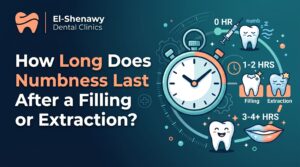
After a routine filling or extraction, the tooth itself usually regains feeling within about an hour, while your lips, tongue, and cheek typically stay numb for 3 to 5 hours. If your dentist used a long-acting anesthetic, which is sometimes chosen for surgical extractions, the soft tissues can stay numb for 4 to 9 hours.
The exact time depends on which anesthetic was used, where it was injected, and how much you needed.
Here’s what affects it, how to stay safe while you’re numb, and when numbness lasts longer than it should.
Why Your Lip Stays Numb Longer Than Your Tooth
Dental numbness wears off in two stages. The nerve inside the tooth, which is what needs to be numb for the treatment, recovers first. The lips, tongue, and cheek, called the soft tissues, recover later, because the anesthetic stays in those tissues longer.
That’s why you can often feel your tooth again while your lip still feels thick or swollen for another hour or two.
How Long Numbness Lasts by Type of Anesthetic
| Anesthetic | Tooth Numb For About | Lips, Tongue, and Cheek Numb For About | Commonly Used For |
| Lidocaine 2% with epinephrine | 60 minutes | 3–5 hours | Most fillings and simple extractions |
| Articaine 4% with epinephrine | 1–2 hours | 2–6 hours | Fillings and extractions, especially in the lower jaw |
| Mepivacaine 3% without epinephrine | 20–40 minutes | 2–3 hours | Short procedures, or when an anesthetic without epinephrine is preferred |
| Bupivacaine 0.5% with epinephrine | 1.5–3 hours | 4–9 hours | Long or surgical procedures where more pain is expected afterward |
Epinephrine is added to many dental anesthetics because it keeps the anesthetic in place longer, so the numbness lasts longer.
Filling vs. Extraction: Is the Numbness Different?
After a filling: Numbness after a permanent tooth filling usually lasts 3 to 5 hours. It often lasts longer for lower back teeth: the bone there is thicker, so the dentist numbs the main nerve instead of injecting next to the tooth, which numbs a larger area, including half of the lower lip, tongue, and chin.
After an extraction: A simple extraction usually has the same 3 to 5 hours of numbness. A surgical extraction, such as an impacted wisdom tooth removal, can last longer, because it may need more anesthetic or a long-acting one that keeps the area numb for 4 to 9 hours.
What to Avoid While Your Mouth Is Numb
- Hot drinks and hot food. You can’t feel heat properly, so it’s easy to burn your mouth without noticing.
- Chewing until the feeling returns. It’s very easy to bite your lip, tongue, or cheek without realizing it. If you need to eat, choose something soft and chew on the other side.
- Testing the numbness. Biting or pinching your lip to check whether it’s still numb can cause painful sores later.
- Leaving children unsupervised. Children often bite or chew their numb lip out of curiosity, which can leave a sore that looks like a swelling the next day. Keep an eye on them until the numbness has completely gone.
Can You Make Numbness Wear Off Faster?
The only method proven to work is a reversal injection (phentolamine mesylate, sold as OraVerse), given by your dentist at the end of the appointment. In clinical trials, patients who received it regained normal lower-lip feeling in a median of 70 minutes, compared with 155 minutes without it.
For the upper lip, it was 50 minutes compared with 133 minutes. It isn’t available at every clinic, so ask before your appointment if you need to talk or eat normally soon afterward.
Walking, gentle massage, or a warm compress are often suggested online. They’re harmless, but there’s no good evidence that they shorten numbness noticeably. Avoid hot drinks or chewing gum to “wake up” your mouth, since both raise the risk of burns and bites.
When to Call Your Dentist About Persistent Numbness
Numbness from a dental anesthetic should be gone by the end of the day. If you’re still numb the next morning, call your dentist.
After a wisdom tooth extraction, numbness or tingling in the lip, chin, or tongue that lasts for days can mean the nerve near the tooth was irritated during the extraction.
This usually improves, but it can take a few weeks or months, so see your dentist to have it checked and monitored.
Comfortable Treatment at Elshenawy Dental Clinics
At Elshenawy Dental Clinics, your comfort comes first, from the first injection until the numbness wears off. Before any filling or extraction, our dentists explain which anesthetic they’ll use, how long you can expect to be numb, and how to care for yourself afterward, so nothing catches you by surprise.
For anxious patients, children, and longer procedures, we offer a full range of dental anesthesia options, from local anesthesia to sedation and general anesthesia. With 5 branches across Cairo and Giza, expert care is always close by.
Book your pain-free visit today at your nearest Elshenawy branch.
Frequently Asked Questions
Will it hurt when the numbness wears off?
You may feel mild soreness at the injection site or around the treated tooth. After an extraction, expect more discomfort; follow your dentist’s pain relief advice and our guide to tooth extraction aftercare.
Can I drive after dental numbing?
Yes, after local anesthetic alone, as long as you feel well. If you were also given sedation, don’t drive until your dentist says it’s safe.
Can I be allergic to dental anesthetic?
True allergy is rare. Seek emergency care if you notice swelling, a rash, or difficulty breathing shortly after the injection.