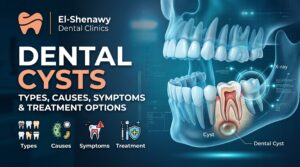
A dental cyst is a pocket of fluid that develops inside the jaw or the gum, most often near the end of a tooth root or around a tooth still buried under the gum. Because it usually grows slowly and without pain, many people only learn they have one when it appears on an X-ray taken for another reason. If it’s ignored, though, a cyst can keep expanding and gradually thin out the bone that holds neighboring teeth in place.
In this blog, we walk through the main types of dental cysts, why they form, how to recognize them, and what treatment looks like for each.
Types of Dental Cysts
| Type | Where It Forms | How Common |
| Periapical (radicular) cyst | Next to the root tip of a tooth whose nerve has died | Roughly 6 in 10 dental cysts, making it the most frequent type |
| Dentigerous cyst | Enclosing the crown of a tooth that never fully came through, usually a wisdom tooth or an upper canine | Around 1 in 5; seen mostly in children and teenagers |
| Odontogenic keratocyst | Within the jawbone | Between 4% and 12%; peaks in the teenage years and the 20s |
| Residual cyst | In the jawbone at the area of an earlier extraction | Close to 5% |
| Eruption cyst | On the gum above a tooth that is just breaking through | Seen mainly in babies and young children |
What Causes Dental Cysts?
In most cases, a cyst traces back either to a tooth that got infected or to a tooth that never came in the way it should. Common triggers include:
- Decay left untreated: when a cavity goes deep enough, bacteria get into the nerve and kill it. The ongoing irritation around the end of the root can then turn into a cyst. Because infection is the most frequent trigger, treating a tooth infection without delay greatly lowers the chance of a cyst developing.
- Trauma to the mouth: a fall or a hit during sports can quietly kill a tooth’s nerve, even when the tooth shows no visible damage, and the dead nerve then triggers inflammation at the root.
- A cracked tooth: even a thin crack can let bacteria travel inward until they reach and infect the nerve.
- A root canal that didn’t fully succeed: when some infection lingers around the root after treatment, a cyst may develop or fail to disappear.
- A tooth stuck under the gum: an impacted tooth, typically a wisdom tooth, can form a cyst around its crown.
- A wisdom tooth that hasn’t fully come in: if only part of the tooth emerges, the gum tissue partly covering it tends to get irritated and swollen repeatedly. Over time, that long-term irritation can lead to a cyst forming alongside the tooth.
- An incomplete cyst removal during extraction: if a tooth with a cyst is pulled but some of the cyst lining is missed, that leftover tissue can keep enlarging inside the healed socket.
- The way the teeth formed: certain cysts, including the keratocyst, grow from cells left behind while the teeth were developing. Nothing the patient did causes these.
Symptoms of a Dental Cyst
A small cyst rarely gives any sign that it’s there. As a cyst grows or picks up an infection, signs like these can appear:
- Swelling of the gum or jaw that doesn’t hurt
- Pain, tenderness, or pus when infection sets in
- A bad taste in your mouth when fluid drains
- Teeth near the cyst moving or becoming loose as the cyst pushes against the bone around it.
- Numbness in the lower lip or chin when a large cyst presses on a nearby nerve.
- In babies and young children, a soft bluish swelling on the gum where a tooth is about to come through
Any new swelling in your gum or jaw is worth visiting your dentist, even when it’s painless.
How Dental Cysts Are Diagnosed
Most cysts are spotted on dental imaging, where they show up as a rounded, darker zone with a sharp edge inside the bone. A panoramic dental X-ray helps a lot at this stage. It provides a view of both the upper and lower jaws, allowing your dentist to assess the cyst’s size and its proximity to nearby teeth and nerves.
Imaging alone isn’t always enough, though, because different kinds of cysts often look very much alike on an X-ray. So to pin down exactly what it is, your dentist may check whether the nerve in the nearby tooth is still alive and send a small piece of tissue to a lab for a biopsy. This step also excludes other problems that can look like a cyst on imaging.
Treatment Options for Dental Cysts
What your dentist recommends will depend on which cyst you have, how big it is, and whether the tooth next to it is worth saving.
- Root canal treatment: Generally, the starting point for a periapical cyst, since clearing out the infected nerve deals with the source of the problem. Find out more about root canal treatment.
- Apicoectomy: When a tooth keeps causing trouble after a root canal, a minor surgery removes the cyst together with the very end of the root.
- Extraction: A tooth that can’t be saved is taken out, and the dentist clears any cyst tissue from the socket so a residual cyst doesn’t form later.
- Surgical removal (enucleation): The cyst is taken out completely in a single procedure. This is commonly used for small dentigerous cysts, residual cysts, and keratocysts. When the cyst has formed around an impacted tooth, that tooth generally comes out during the same procedure, which in most cases means wisdom tooth removal.
- Marsupialization: An approach for large keratocysts. Instead of removing the cyst straight away, the surgeon makes an opening that lets it empty and gradually shrink, sparing the bone and teeth around it. Once the cyst becomes smaller, a follow-up procedure may be needed to remove the tissue left behind.
Eruption cysts typically resolve without treatment in young children, as the swelling usually opens and subsides once the emerging tooth breaks through the gum.
Once treatment is done, follow-up X-rays show whether the bone is filling in and whether the cyst has stayed away.
Dental Cyst Treatment at Elshenawy Dental Clinics
Hearing the word “cyst” can be worrying, but most dental cysts are treated simply and successfully. At Elshenawy Dental Clinics, we start with digital X-rays and 3D scans that show exactly where the cyst is and how close it sits to your teeth and nerves, so your treatment plan is based on a clear picture, not guesswork.
Whenever possible, we save your natural tooth. If your cyst needs to be removed surgically, the procedure is carried out at our clinic by dentists who handle these cases regularly. For people who find dental surgery stressful, or whose cyst is larger or harder to reach, we can also perform it under general anesthesia, so you stay relaxed and pain-free from start to finish. Follow-up X-rays then confirm the bone has healed completely.
Don’t let a cyst grow unnoticed. Book your assessment with Elshenawy Dental Clinics today.
Frequently Asked Questions
Can a dental cyst go away on its own?
For most cases, no. Eruption cysts in children are the exception. Periapical cysts are usually treated with root canal therapy, while other types generally require surgical removal.
Will antibiotics get rid of my dental cyst?
Not on their own. They can calm an infection in the area, but the cyst stays until its cause is treated or it’s taken out.
Can my dental cyst come back?
Recurrence is rare when the cyst is completely removed. Keratocysts are the main concern, returning in about 20–62% of patients depending on how they were treated, which is why your dentist will schedule follow-up X-rays.
Is my dental cyst cancerous?
Dental cysts are benign, meaning they aren’t cancer. Some other jaw problems can look similar on imaging, though, so a biopsy may be done to confirm the diagnosis.